 Skip to main content.
Interview
Evgeniy Nastradin: Telecom today is the digital infrastructure on which people's lives and national economies are built
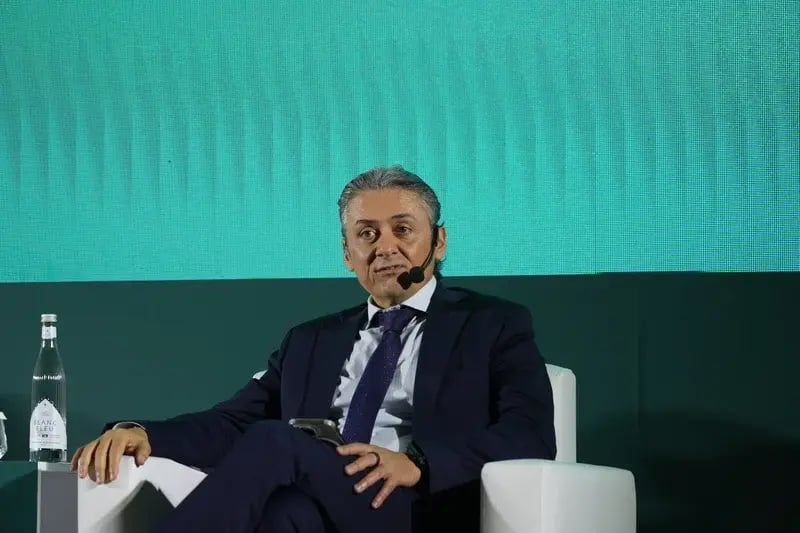
Evgeniy Nastradin: "Telecom today is the digital infrastructure on which people's lives and national economies are built"
Beeline Uzbekistan is a digital operator developing telecommunications, digital services, and ecosystem solutions in the Uzbekistan market. CEO Evgeniy Nastradin on where telecom is heading, why an operator needs an ecosystem, the company's participation in the region's premier telecom event M360 Eurasia, and what lies behind the concept of Government 4.0.
Telecom is undergoing serious transformation. How is the industry's focus shifting, and how does that translate into the customer experience?
Telecom today is experiencing what is arguably its most profound transformation in decades. Where operators were once synonymous with connectivity, our role today is far broader — we are becoming the digital infrastructure underpinning people's lives, business operations, and government services.
This shift is clearly visible in how customers actually behave. In Q1 2026, mobile data consumption per subscriber grew 64.5% year-on-year, reaching 23.1 GB. People are increasingly living their lives in the digital space — working online, using fintech services, streaming content, accessing government services, learning and communicating through digital platforms.
Against this backdrop, telecom itself is changing. Customers no longer simply expect a stable network — they expect a seamless, fast, and secure digital experience end to end. This is why we are investing heavily in digital services, and demand is growing rapidly. Revenue from digital services is up 39.8%, with their share of quarterly revenue reaching 13.7%.
These services are no longer considered add-ons to connectivity. They are, above all, a reflection of how people genuinely engage with our products every day — and a clear signal of where the industry needs to go next.
Which of Beeline Uzbekistan's digital services and platforms are seeing the strongest demand right now?
We are seeing strong demand across virtually all digital services within the Beeline Uzbekistan ecosystem. Among the most in-demand is hambi, our super-app, which had 3.4 million users at the start of this year. It brings together multiple everyday services within a single ecosystem.
Our fintech vertical is also performing strongly: Beepul, our payment service, has reached 1.7 million users.
I would also highlight OQ, our platform for younger audiences — its user base has more than doubled, reaching 1.1 million users.
And I should mention Uklon — which recently joined the VEON group — now the second-largest ride-hailing service in Tashkent. In 2025, Uklon users in Uzbekistan completed around 15 million rides — it has become a genuine part of people's daily lives.
These numbers tell a clear story: the services with the greatest traction are those that become part of users' daily routines — from payments to content and digital platforms for communication and learning.
Beeline Uzbekistan is actively involved in advancing the Government 4.0 concept. What does that mean in practice?
Government 4.0 represents a shift from digitising individual services to building a fully integrated digital state — one where services operate proactively, seamlessly, and on the basis of data.
In practice, this means the telecom operator becomes part of a country's critical digital infrastructure. We are no longer talking only about connectivity — we are talking about technologies that enable scalable digital public services, cloud solutions, AI-driven tools, IoT, and secure data exchange.
For the individual, this should feel effortless: accessing a service, completing documentation, making a payment, or interacting with government should be fast and frictionless — without bureaucracy or complexity.
This, in my view, is the role of the modern operator: to be a technology partner in a country's digital transformation.
Is the market ready for digital ecosystems of this scale?
I believe the market is already generating that demand organically. We see it in how rapidly user behaviour is evolving. People want everything within a single digital environment: connectivity, financial services, content, government services, and everyday utilities. And it is important to understand — an ecosystem is not about the number of applications. It only works when it genuinely simplifies life and saves people time.
Uzbekistan as a whole is an exceptionally strong environment for digital transformation. We have a young, dynamic population, a rapid pace of technology adoption, and strong government commitment to digitisation. Beeline Uzbekistan's digital audience alone stands at approximately 8.2 million users.
This allows us to build infrastructure for tomorrow's needs from the outset, without retracing the decades-long journey other markets have had to travel. So the question is no longer whether the market is ready for digital ecosystems — it is how quickly companies can adapt to these shifts and deliver a genuinely high-quality digital experience to their customers.
What comes next? How does telecom's evolution continue?
The next phase is the transition from pure connectivity to intelligent digital infrastructure. Where operators once provided connectivity, our task now is to create an environment in which digital services, AI, and data function as a unified ecosystem — one that anticipates customer needs, personalises services, and makes the digital environment as seamless and effective as possible.
We are already seeing how artificial intelligence is reshaping the industry: from network management and cybersecurity to service personalisation and customer experience. And in the years ahead, this transformation will only accelerate.
At the same time, the operator's role is expanding. Telecom is becoming a platform for the development of a country's digital economy — spanning fintech, cloud solutions, smart cities, IoT, and digital public services.
In my view, the competition of the future will not be fought on networks or tariffs alone. It will be fought on the speed of innovation and the quality of the digital environment a company is able to build around the individual.
Beeline Uzbekistan has partnered with M360 Eurasia for the second consecutive year. What matters most to you about this forum?
The most meaningful outcome of M360 Eurasia for us was not participation in itself, but how precisely the forum captured the current moment in the industry's development. One idea came through with particular clarity: telecom today is no longer about connectivity as a product — it is about the digital infrastructure on which national economies are built.
We found strong alignment with the agenda: AI, digital ecosystem development, the operator's role in Government 4.0, data security. These are exactly the areas in which we are already moving as a company, and the forum confirmed that we are advancing in step with the global industry.
It was equally important for us that M360 provided an opportunity to validate our strategy against international players and regulators — where the market is heading, which models will prove sustainable, and where the boundaries between telecom, fintech, and digital services continue to dissolve.
If I were to distil one key takeaway, it is this: the pace of change in the industry is no longer linear. And the winners will not be those who simply adapt — but those who are able to shape an ecosystem and set the direction of digital experience for their users.
I would also note separately: M360 Eurasia being held in Uzbekistan for the second year running is itself a statement — the region is becoming a full participant in the global digital agenda. For us, that is an important signal of market maturity and further confirmation that the strategic direction we have chosen is aligned with the broader trajectory of the industry.