 Skip to main content.
Press Release
From Connectivity to Computing Power: ZTE on Central Asia’s AI Future

At GSMA M360 Eurasia 2026, the spotlight was on three pillars: AI, connected infrastructure, and regional digitalisation. In this interview, Mr. James Zhang, Senior Vice President of ZTE and President of the Asia-Pacific and the CIS, shares practical insights from across Central Asia, highlighting how countries like Uzbekistan and Kazakhstan are moving beyond basic connectivity toward intelligent, sustainable digital ecosystems. From modular data centres to university partnerships and energy‑efficient AI, the conversation reveals what it takes to build a truly local digital future.
What do you see as the main trends across Central Asia?
James Zhang: Across the region, we see a shift from simply providing coverage to building smarter, more reliable digital ecosystems. Data traffic is growing fast, especially in cities, and networks need to handle that without constant physical expansion. At the same time, governments are prioritising digitalisation as an economic driver.
Globally, the last few years have seen a significant shift – ICT investment is moving from “network” to “computing power”. The AI revolution, sparked around 2022, has made computing capacity as important as connectivity. This is not just a trend in advanced economies; Central Asia is also beginning to feel it. Operators and policymakers are starting to ask not only how to connect people, but also how to process the vast amounts of data that connected devices generate. The real question for the region is how to scale both network and computing infrastructure in a way that is secure, cost‑effective, and sustainable over the long term.
Take ZTE’s work in Kazakhstan: we helped bring gigabit level speed to hundreds of thousands of families, enabling online education and remote work. In Uzbekistan, similar large‑scale network modernisation projects have significantly improved coverage and speeds. We have also built modular data centres, like the Bukhara facility, and AI‑ready computing centres. In Kazakhstan, modernisation using advanced antenna technology increased 4G throughput without adding new towers, and autonomous solar‑wind powered sites now provide coverage where no grid exists. The supercomputer at Al‑Farabi Kazakh National University, another ZTE project, supports local AI research. These examples show that infrastructure can be upgraded at scale using existing sites and renewables, or built from scratch for advanced computing.
How is AI relevant for digitalisation in Central Asia today?
James Zhang: AI is already making networks more efficient in practical ways. For instance, AI algorithms can adjust how a network beam directs signals in real time, improving user experience without adding hardware. Predictive maintenance – using data to prevent failures before they happen – is another example.
Looking ahead, the next two to three years are expected to be a critical period for AI to move from pilot exploration to large‑scale deployment. This will bring profound changes to the entire ICT industry. One direction is the evolution of core networks from cloud‑native to AI‑native – where network operations become more automated and responsive to user behaviour, shifting from a network‑centric to a user‑centric model. In practice, this helps operators move beyond simply providing connectivity to offering more valuable digital services.
For Central Asia, this evolution is relevant because it directly affects how operators can generate returns on their network investments. The region does not need to start from scratch – many of these AI‑enabled capabilities can be built on existing infrastructure.
At the same time, AI requires skills. In Uzbekistan, for example, our partnership with Tashkent University of Information Technologies (TUIT) is helping introduce AI, cloud computing, and telecoms into student programmes, including hackathons and internships, with the possibility of full-time employment afterwards.
Moreover, the core metric of AI competition is changing. It is no longer only about who has more computing power, but who delivers intelligence most efficiently. This is critical as AI Agents and large-scale inference go mainstream, making workloads highly dynamic and unpredictable. This is where ZTE’s system-level design creates value. We are building an E2E intelligent foundation. On one hand, we improve system-level efficiency through advanced liquid cooling and modular data centers. On the other hand, we combine green energy, energy storage, intelligent energy management and computing scheduling to create a safer and more resilient energy system. True efficiency cannot come from a single component. It requires deep synergy across facilities, networks, and computing. For instance, in our project with Tencent, our integrated energy-saving tech slashed energy consumption by 30%, keeping PUE below 1.25. This end-to-end innovation maximizes "Tokens per Watt" and delivers the ultimate cost structure for our customers' future AI operations.
So AI is both a current operational tool and a long‑term skills challenge for the region.
What about local capacity building?
James Zhang: Sustainable digitalisation depends on local expertise. ZTE opened a regional service centre in Tashkent, creating jobs and upskilling engineers. University cooperation like the TUIT model – hands‑on labs, internships, direct recruitment – bridges theory and real‑world operations. Projects like the Bukhara data centre and the KazNU supercomputer also leave behind local knowledge. The key is that international projects must leave a skilled local workforce, not just hardware.
What are the main obstacles to scaling digital ecosystems in Eurasia, and how can they be addressed?
James Zhang: Three obstacles stand out. First, investment needs – infrastructure is capital‑intensive and returns take time. Second, regulatory alignment – spectrum allocation, data protection, cybersecurity standards. Third, reliable power supply, especially in remote areas. None of these are unique to this region. Solutions include public‑private dialogue, pilot projects that demonstrate feasibility, and regional cooperation on standards. For example, the off‑grid solar‑wind sites on a Kazakh highway that we implecated with Beeline shows that renewable energy can solve power challenges in remote locations. Such pilot projects can be replicated across the region.
What message would you share with policymakers and industry leaders at GSMA M360 Eurasia 2026?
James Zhang: Focus on fundamentals: resilient infrastructure, local skills, consistent regulations. Recognise that AI and computing power are as important as connectivity. Central Asia should create an environment where network and computing investments grow together, supporting local research, startups and public services.
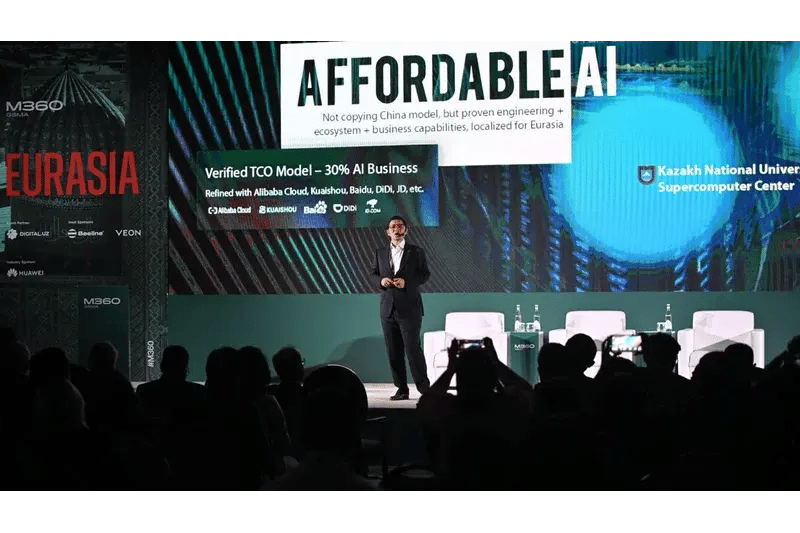
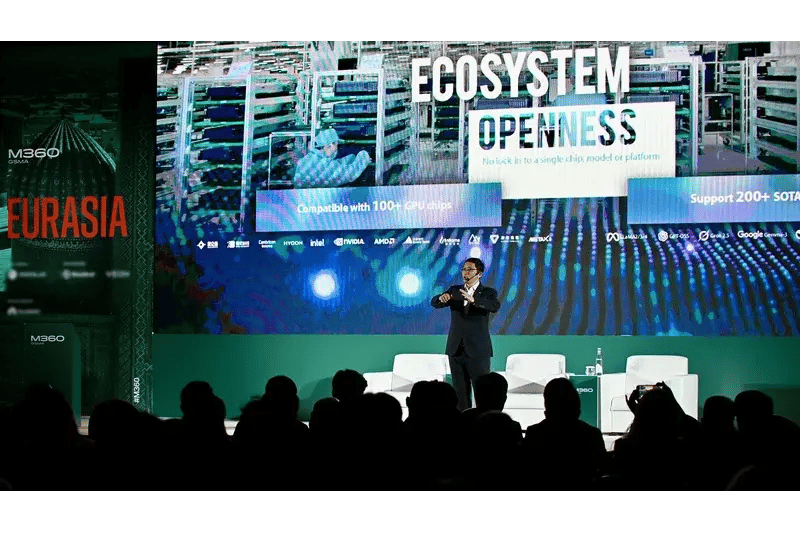
I believe future AI infrastructure needs three capabilities. First, supply assurance – Sovereign AI must be built on stable, deliverable, and continuously evolvable foundations. ZTE serves over 500 operators and 2 billion users across 160 countries and regions, so we know how to deploy complex infrastructure at scale. Second, ecosystem openness – no lock‑in to one chip, one model or one technology path, ZTE’s open platform already supports over 100 types of GPU and is compatible with more than 200 SOTA models.. Third, cost‑effectiveness – AI must be powerful enough for top tiers yet affordable for SMEs. Affordable AI means better total cost of ownership, not low quality.
When building affordable AI, China’s mass-scale digital economy offers a blueprint, but our goal is not simple copying. Every market has unique regulations, energy and customer needs. The real value is taking proven engineering and business capabilities and integrating them locally. In Eurasia, projects like the Bukhara data centre and the KazNU AI infrastructure prove that intelligent infrastructure aligns with local market needs.
Finally, look at what is already working in the region and adapt it, rather than always importing external models. There is enough momentum to build secure, trusted and inclusive digital ecosystems. Today’s decisions will decide whether Central Asia becomes a benchmark for digital transformation in emerging economies.